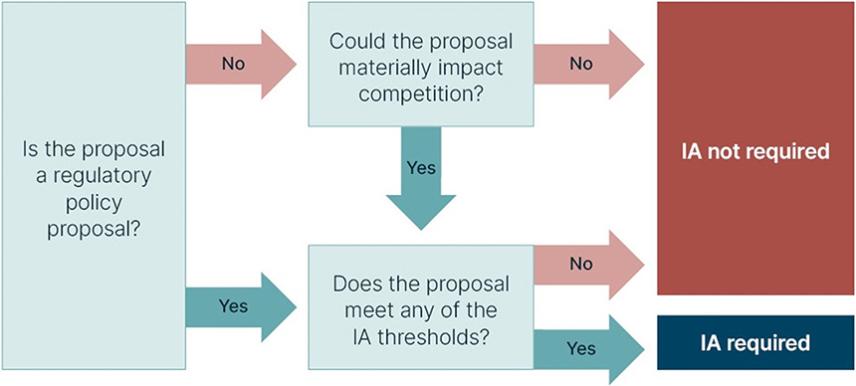
1.1 When is an IA required?
An IA ensures that robust evidence and analysis on the likely impacts is available to decision‑makers to inform a decision.
Impact analysis is only required for:
- regulatory policy proposals, or
- proposals with material competition impacts.
1.2. What policy proposals are in scope?
Regulatory policy proposals: any proposal to establish or reform government rules that set requirements. This includes quasi-regulations, such as industry-government agreements (co-regulation), which influence the behaviour of people, businesses, or community organisations.
Proposals with material competition impacts: any proposal expected to have a material (positive or negative) impact on competition in a market. This includes material impacts on:
- barriers to set-up (or exit) for businesses, organisations or workers
- the ability or incentives for businesses to compete
- changes to the choices, information, goods or services available to consumers.
Policy proposals to change arrangements for certain government-funded goods and services (such as, health and education services), taxes and subsidies that may have material competition impacts depending on the nature of the proposal.
For in-scope proposals, Cabinet and other government decision-making process including delegated decisions by ministers, secretaries and heads of agencies are covered by the framework.
1.3. In-scope proposals must also meet the IA thresholds
The IA thresholds provide guidance on where in-scope proposals are likely to have a significant impact on the Australian economy, people, businesses, organisations or the community. Agencies must self-assess if a proposal meets one or more of the IA thresholds. Agencies can seek guidance from the OIA when undertaking these assessments.
In-scope proposals that are expected to meet or exceed one or more of the following IA thresholds require an IA to inform a policy decision.
IA threshold 1 (regulatory burden): proposals likely to change regulatory burden by $20 million or more in total (over 10 years).
Regulatory burden captures the change in compliance and delay costs imposed by a policy change on people, businesses, and community organisations. The practical guide can support estimating regulatory burden, both for assessing threshold 1 and as part of the IA.
IA threshold 2 (material impacts): proposals likely to have indicative impacts of $200 million or more annually on the economic and social outcomes for people, businesses, or community organisations.
The Practical Guide for Agencies covers how to assess the indicative impacts, including economic, competition and social impacts. This covers guidance for assessing threshold 2, as well as approaches to assessing these impacts in the IA.
IA threshold 3 (distributional impacts): proposals likely to disproportionately and significantly impact a cohort, including small businesses, where no other impact assessment applies.
Where proposals have disproportionate and significant distributional impacts, these should first be considered within other established Australian Government impact assessment frameworks or similar processes (for example, assessments related to First Nations impacts, gender impacts, or regional impacts), which operate alongside the IA framework to inform decision-making.
Figure 1. Scope and thresholds